Nexthen
From Scattered Intent to the Next Right Action
Summary
Nexthen is a task board where the person's own AI assistant does the hard part of a to-do list, which is deciding what to do and getting started. The person talks to the assistant they already use. It files each task into the right category, names one task to do next with one plain reason, and turns a task that feels too big into the next physical action that it walks through step by step.
It does this with methods from 19 books on productivity and psychology, fitted to the person through a profile that starts with a short questionnaire and grows as the assistant sees how they work. When a task keeps getting avoided, it makes the first piece smaller and gives a practical reason instead of pressure.
Overview
- Sorts whatever the person says into tasks and categories.
- Names one task to do next and why.
- Turns a task that feels too big into small physical steps and walks through them.
- Learns how the person works through a questionnaire and a growing profile.
- Grounds its methods in 19 books on productivity and psychology.
- Hands research to the AI as tasks linked to the person's own work.
- Runs on the AI assistant the person already uses.
Role
- Product Designer and Systems Designer
- Product concept, developed from a paper planner
- Information architecture and interaction model
- Assistant work process, questionnaire, and profile
- Book research and knowledge preparation
- Interface design and design system
- Assistant connection and change validation
- Full-stack development
- Deployment and operation
Nexthen.now helps you work out what comes next, then what to do now.
Nexthen is a to-do list on one screen with an AI assistant that knows how you work and draws on nineteen books about getting things done, and it runs on the AI subscription you already have.
00. Table of Contents
The idea the product is built on.
02. From Paper to One ScreenThe daily sheet of paper it grew from.
03. The Assistant Is the AI You Already UseClaude, Claude Code, Codex, and ChatGPT connected to one board.
04. Getting It Out of Your HeadAdding tasks by saying what is on your mind.
05. Working Out What Comes NextOne task with one plain reason.
The next physical action, one step at a time.
07. It Knows YouThe questionnaire, the profile, and the three help levels.
08. The Books Behind ItNineteen books condensed into nine working rules.
09. A Task List for Your AIWork an AI picks up later, linked to your own task.
10. Node ViewWhat depends on what, across categories.
01. Why It Exists
Nexthen exists to help a person get into motion and stay there.
Most people carry far more that they want or need to do than fits into a day, and the hardest moment is usually the start. In physics, what is in motion stays in motion, and work behaves in a similar way, because once one task is moving the next step is easier to take. A great deal is already known about how people get things done, from research and from books on productivity and psychology, so I built Nexthen to apply that knowledge to one person's own list.
- 01A full listEverything a person wants or needs to do.
- 02One small next stepSmall enough to start.
- 03MotionOnce one task is moving, the next step is easier to take.
02. From Paper to One Screen
Nexthen began as a sheet of paper that I printed and filled out every day.
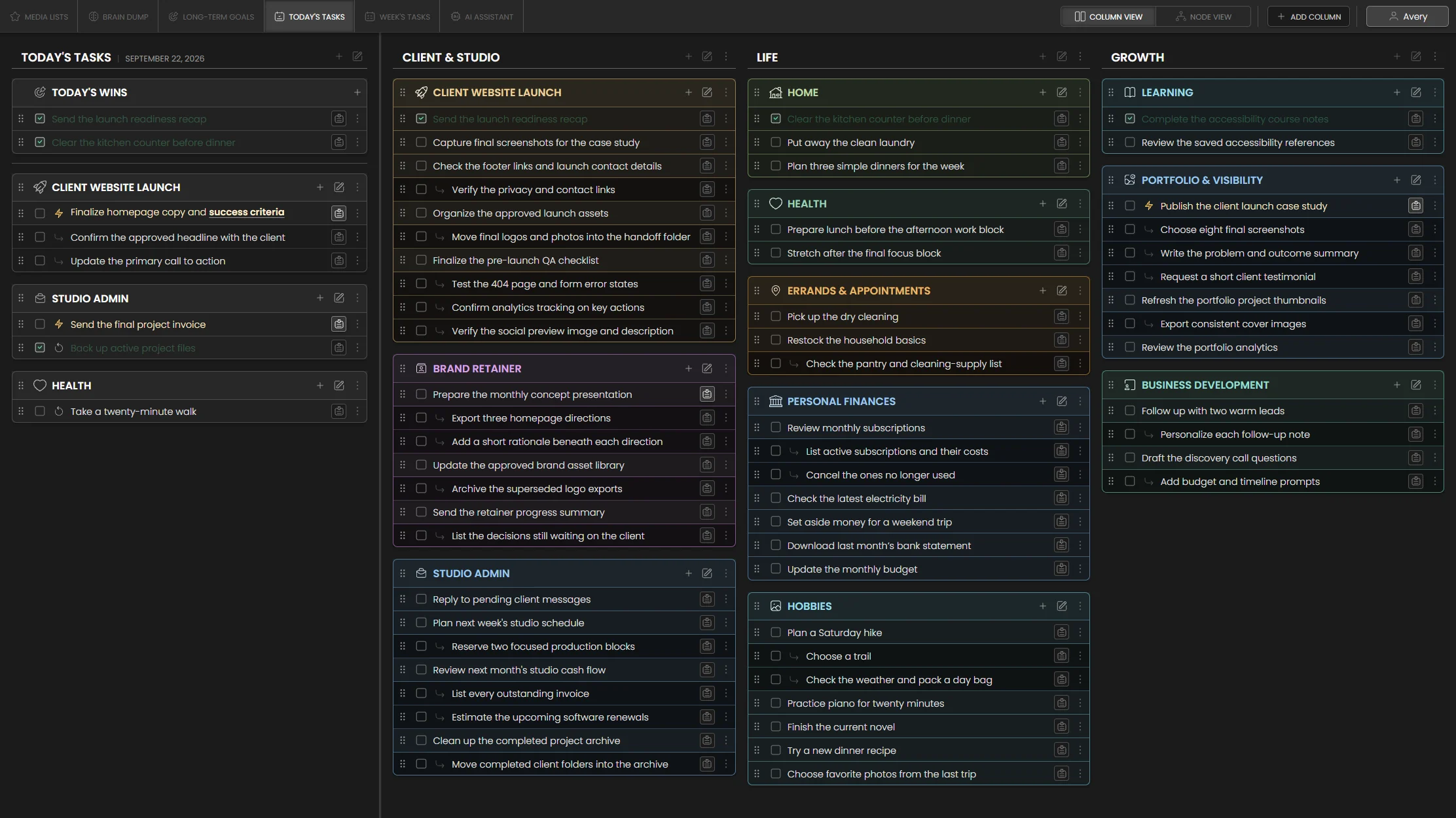
The paper worked because everything was in view at once, with the week on the left page and the current day on the right, and nothing had to be opened to find the rest. Nexthen keeps that. Every column and category sits on one board, a new task is typed straight into the category where it belongs, and the day and the week are views of those same tasks, so nothing exists twice.
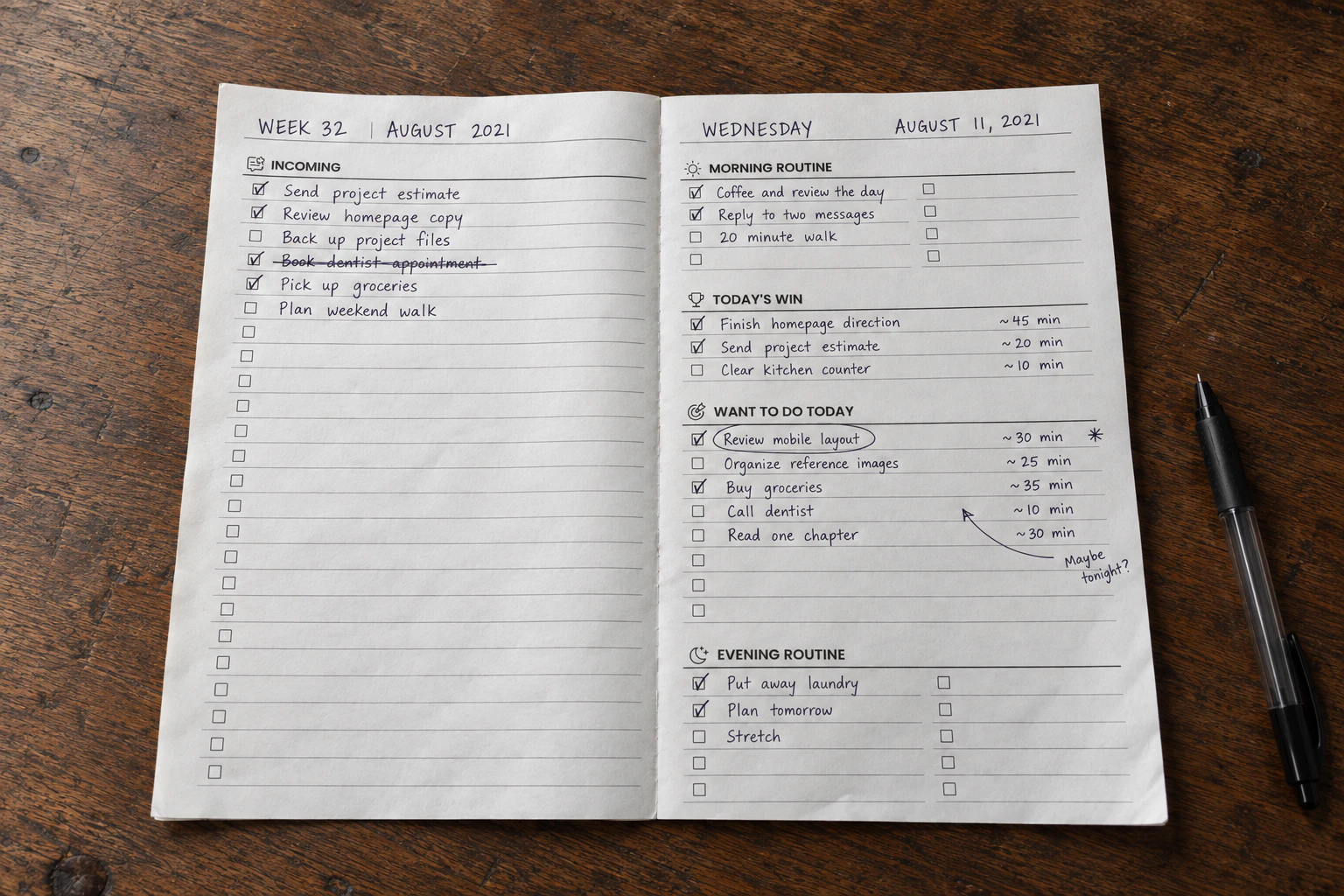
- Incoming
New things get written down first and sorted later.
- Today's Win
The one thing that matters most today stands at the top of the day.
- Routines
Recurring tasks stay on the page so they are not forgotten.
- Week and Day
The week and the current day sit side by side.
Every category can be given its own color, which covers its heading and its rows, so the categories stand apart as blocks and can be told apart without reading the headings.
03. The Assistant Is the AI You Already Use
Nexthen has no AI of its own, because it connects to the assistants a person already uses.
The Claude app, Claude Code, Codex, and ChatGPT can each be connected to the board, after which they can read it and change it in the same way the person can, from a computer or from a phone. A task mentioned to Claude on the phone appears on nexthen.now a moment later, and the person pays nothing beyond the subscription they already have. Every change an assistant makes is checked against the current state of the board and can be undone, so an assistant cannot overwrite newer work without anyone noticing.
- Claude app
- Claude Code
- Codex
- ChatGPT
One boardnexthen.now, read and changed by each of them
04. Getting It Out of Your Head
Tasks can be added by telling the assistant what is on your mind.
A person can write or speak to the assistant in normal language, the way they would in a conversation, and mention things as they come to mind, even when the thoughts jump between topics. The assistant first builds a picture of everything that was said, so that the board does not fill up with fragments and duplicates. It then works out which parts are tasks, which category each one belongs to, what is urgent, and which tasks are connected, and it places everything on the board in an organized way.
This also helps people for whom deciding what to write down is already overwhelming, which can be the case for neurodivergent people, including autistic people and people with ADHD. When building the list becomes a task of its own, it is often the first thing to be avoided, and being able to talk freely removes that step. Research points the same way. Large reviews find differences in planning and working memory in ADHD and autism on average, autistic adults describe difficulty starting tasks even when they want to and say that help with naming the first step makes starting easier, and writing a plan down outside the head is a well-studied way to reduce mental load.
05. Working Out What Comes Next
When asked what to do, the assistant names one task and gives one plain reason.
The assistant does not read the list back to the person. It looks at where the person is, how much time they have, how much energy is left, and which of the remaining tasks pays off most, and it asks at most two short questions when it cannot tell. The answer sounds like "This one unblocks three others" or "This takes ten minutes and gets the form off your plate." The day itself is kept small as well, because Today's Wins holds at most three tasks and opens with the question "What can you finish today that will make life easier?"
06. Then Starting Now
A task that feels too big is turned into the next physical action.
The assistant asks what finished would look like, keeps the task as that outcome, and adds only the next one to three steps, each of them something a person can do with their hands, such as opening the folder with last year's tax return. On request it walks through the task one step at a time and ticks each step on the board, and it can pick up at the right place days later, because the steps are saved on the board. When a task keeps getting put off, the first piece becomes smaller still, sometimes only the first minute, and the reason the assistant gives is always a practical one, with no deadline pressure and no judgment.
07. It Knows You
The assistant builds a profile of the person, so its help fits how that person works.
People are productive in different ways, at different times of day and with different kinds of support, so Nexthen starts with a short questionnaire that covers, among other things, the time of day a person works best and what usually stops them from starting. The person can add their goals and anything else the assistant should know about them.
From these answers the assistant writes a profile and uses it whenever it helps the person prioritize or plan, and it keeps adding to the profile as it sees how the person handles their tasks. The person can ask what the assistant has learned about them, or why it made a suggestion, and it answers with the exact line in the profile that the suggestion came from, which the person can then correct. The person also chooses how much the assistant should guide them, with three levels that range from helping only when asked to naming the next task.
08. The Books Behind It
The help is grounded in nineteen books on productivity and psychology.
A great deal of what is known about getting things done sits in books that few people have the time to read and apply. Nexthen's assistant has all nineteen available, prepared passage by passage, and it reads the relevant passage before relying on it, so its advice can be traced to a source. The books are condensed into nine working rules, which the assistant follows whenever it helps.
- Plan demanding work for the hours when the person's head is clearest.
- Choose the next task by place, available time, energy, and payoff.
- Prefer the smallest action that has the largest effect.
- Find what makes a task hard to start, whether time, money, physical effort, mental effort, or fit with the day, and make that one thing easier.
- Start on some small part of a task when starting the whole feels impossible.
- Turn a project into the next visible action.
- Do a little of what matters today, before everything else fills the day.
- Acknowledge a small finished step, because that makes the next one easier.
- Treat chores and paperwork as practical tasks that say nothing about a person's worth.
09. A Task List for Your AI
Work that needs AI help goes on the board as a task for the AI.
Some tasks need research or preparation before a person can do their own part. That work is written into the AI Assistant list as its own task and linked to the task it serves, so choosing a new accounting tool can wait on an AI task that compares three options first. The AI does not have to be briefed at that moment. It picks up the list later, decides the order, shows each task as in progress while it works, leaves its answer on the task, and marks it complete, and the person deals with the result when the time comes for their own task. A reply to an answer becomes a new linked task when more is needed, and answers worth keeping are stored in Saved Responses.
When more is needed, the reply becomes a new linked task.
An answer worth keeping is stored there.
10. Node View
Node View shows how tasks in different categories are connected.
On the board, tasks are grouped by category, which hides the fact that a task in one area often depends on a task in another, or makes another one easier. Node View lays the categories out as a map and draws lines between connected tasks, including the links between a person's own tasks and the AI tasks that support them, so a person can see which task has to happen first and what finishing it will unblock elsewhere.