BasicsOf.AI
A Verified Plain-Language AI Reference
Summary
BasicsOf.AI is a free, plain-language encyclopedia that helps people understand AI without a technical background. Each article starts with a short answer, explains the concept through examples, and addresses common misconceptions. Readers can follow the cited sources to check the explanation and explore the subject further.
A system for producing and maintaining reference content checks claims against original research and official documentation. Deterministic checks block publication when citations cannot be resolved or claims are flagged as wrong or fabricated. Content across multiple languages follows the same verification process, and time-sensitive information is scheduled for review as its sources change.
Overview
- Explains AI concepts in plain language.
- Checks claims against original research and official documentation.
- Uses deterministic checks to block unresolved citations and flagged errors.
- Applies the same verification process across multiple languages.
- Schedules time-sensitive information for review.
- Structures content for discovery and citation by search and AI tools.
Role
- Systems Designer and Developer
- Content production and maintenance workflows
- Source verification and deterministic publication checks
- Multilingual content workflows
- Information architecture and reader experience
- Search visibility and AI citation structure
00. Table of Contents
So many sources, so many errors, and no single reliable place to learn AI.
02. The BuildWhat BasicsOf.AI is, and who it is for.
03. The Content EngineThe system behind the content, and the principle that makes it trustworthy.
04. Why It Can Be TrustedWhy instruction alone fails, and what the model cannot talk its way past.
05. The Triple Audit and the GateIndependent verification and a hard stop that a fabricated fact cannot pass.
One engine, proven across very different domains and languages.
07. Built for CitationWhy the research moved the goal from blue links to being the cited source.
08. The Website LayerThe reader, the navigation, and the model-and-tool directory.
09. MeasurementThe accuracy is measured against a golden set with known answers.
10. OutcomeWhat is live, what the engine guarantees, and where it goes next.
01. Context
The tools most people now reach for to understand AI are the same tools that get AI wrong. Ask ChatGPT or Gemini what an LLM is and the answer arrives fluently, inline, with no source and no way to check it, and sometimes it is confidently incorrect. Reddit threads on machine learning are full of the same aftermath, where someone reports that an AI explained a concept the wrong way and they almost did not catch it.
Underneath that is a vocabulary problem specific to this subject. People say "AI" when they mean an LLM, "algorithm" when they mean a trained model, and "deep learning" when they mean machine learning. The audience that most needs a correct mental model is the audience least equipped to tell a correct explanation from a plausible one.
The existing material splits into two unhelpful extremes. On one side are shallow, ad-heavy content farms that are vague, often outdated, sometimes wrong, and carry no audit trail. On the other are dense academic papers and university courses that assume math and code. There is no clean, neutral, well-organized, primary-source-audited middle written for a normal person who just wants to understand it.
A calm, source-cited reference is the direct antidote to the exact thing people are getting burned by.
The material that already exists is riddled with inaccuracies, and there is no single reliable place to learn this. Explainers contradict each other and carry outdated or wrong numbers stated with confidence, and the AI tools people reach for answer the same questions just as confidently with no source to check. That gap is why this exists. The aim was reference content accurate and maintainable enough to put my name on, which the ordinary approach of prompting a model and publishing what it returns cannot deliver, because that approach produces content that reads as correct with no guarantee that it is.
02. The Build
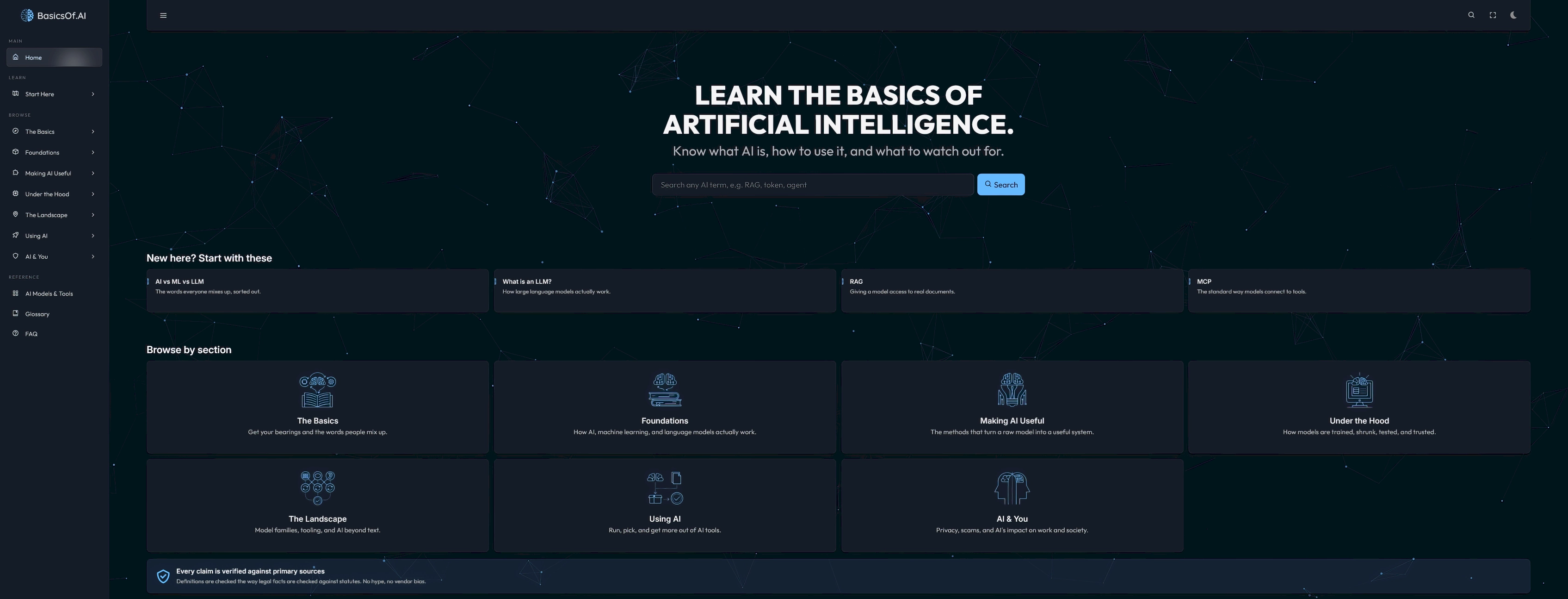
BasicsOf.AI is a free, neutral, plain-language encyclopedia for anyone who wants to learn how AI works. After reading an article a person should be able to follow an AI conversation, read a product announcement critically, and know what the words actually mean.
Every article is self-contained, with a short answer up front, an explanation of what the concept is and why it matters, the key terms, examples and analogies, common misconceptions, and the cited sources. Time-sensitive facts carry a visible snapshot date and a re-verify schedule, so a number that was current on launch day does not quietly become a lie six months later.
What sets it apart is that every factual claim traces to a primary source, checked the same way a legal claim is checked against a statute. That guarantee comes from the machine described in the next section, which is the actual asset and the reason this project exists.
03. The Content Engine
The Content Engine is a reusable system for producing and maintaining content that has to be factually correct and trace every claim to a primary source. It runs across my client work, and the hard part is making it hold across many different fields and keep holding as their facts change. This encyclopedia is one of the subjects it powers.
What runs underneath is more involved than a case study can show. What matters here is the principle, because the trust in the output comes from how the whole system is shaped. The sections that follow lay out that core concept.
This is for work where accuracy is the product, where the claims are verifiable, errors are costly, sources have to be cited, and the facts keep changing. That spans legal, medical, financial, technical, and educational content, anywhere being wrong has a real consequence.
Anyone can prompt a model. The work is in everything that surrounds it.
04. Why It Can Be Trusted
A set of prompts that says "be accurate, cite your sources, do not hallucinate" does not work, because models produce confident falsehoods regardless of how carefully they are instructed. The accuracy comes from the deterministic scaffolding wrapped around the model, the parts the model cannot talk its way past. The prompts are the labor, and the spine is the accuracy, built from four mechanisms that hold whatever the model is asked to do.
04.01. Grounding
Secondary sources such as news and blogs are allowed only to discover what to look at. The claim itself is checked against the primary source, the provider's own documentation, the model card, the original paper, or the official specification, fetched live and read through code so the check sees the real text. This stops error compounding from secondhand reporting.
04.02. Independent verification
A second model re-checks the work in a fresh context with no view of the first model's reasoning. Because it never saw the writer's framing, it cannot inherit the writer's error. The independence is structural, enforced by how the agents are run.
04.03. Deterministic gates
A citation must resolve against a real source or the claim is blocked. A claim rated FABRICATED or WRONG against the fetched source halts publication. These are hard stops in code, which is why a hallucinated fact cannot reach the site even when an upstream agent believes it.
04.04. Measurement
An eval harness and a calibration tool report, empirically, whether a given safeguard actually prevents a mistake. The claim that the system works is therefore one I can falsify, which is the difference between an engineered guarantee and a marketing one.
Grounding a model in retrieved primary sources, having a second model verify the first, enforcing hard guardrails, and judging the system against an eval set are the same engineering patterns that sit under serious AI in high-stakes fields, from legal tools like Harvey and CoCounsel to medical systems that answer from an authoritative corpus. The Content Engine brings that discipline to every claim it publishes.
Remove the prompts and there is nothing to run. Remove these four and you have astrology.
05. The Triple Audit and the Gate
The obvious way to verify AI-generated content is to have another AI read it and confirm it looks reasonable, but that only automates agreement. A verifier reading the writer's output in the same context is already primed by the writer's framing, so it tends to confirm a plausible paraphrase without ever opening the source.
After content is written, three independent auditors check different dimensions and do not share context with the writer or with each other. The accuracy auditor re-reads the actual primary source and checks the claims against it, catching wrong numbers, outdated facts, and oversimplified mechanisms. The citation auditor confirms that URLs resolve, that numbering is consistent, and that sources are authoritative. The SEO auditor checks titles, summaries, structure, and length. Running them in parallel, each with its own focused prompt, avoids the attention degradation a single agent would suffer trying to hold all three dimensions at once.
Before the audit, a claim-verifier extracts every verifiable claim and rates it against the fetched source as CONFIRMED, WRONG, PARTIALLY CORRECT, FABRICATED, or UNVERIFIABLE. A WRONG or FABRICATED rating is blocking and must be fixed before the content can advance. This gate is the reason a confidently invented fact cannot survive the pipeline.
No single AI invocation in this system is trusted as the final word.
06. Proving It Generalizes
The engine is built to work in any domain, and this project tested that against a field about as far from its origin as possible. It already runs a six-site legal reference platform where every claim is verified against the statute books, and bringing it to AI meant aiming the same machine at a fast-moving technical field where the primary source is a provider's documentation or an arXiv paper. The subject matter and the source types have nothing in common, and the same pipeline holds across both.
Adapting it to AI took a single domain configuration and two small AI-specific agents, a change-scanner and an integrity-checker. The engine lives in a global skills layer decoupled from any website, and it meets a site only at the final step where verified content is written into the database, which is how it could be built and measured before this website existed.
The same design extends across language. A German edition runs as a dimension of the same engine, with its own voice skill, a locked glossary, a localizer agent, and the same fact-and-voice gate, and the first localized articles passed that gate at full fact parity with no drift, which confirms the verifier re-checks German claims against the same primary sources. The machine that holds across domains holds across languages.
07. Built for Citation
Before building the site I ran a demand-and-distribution study, because an accuracy engine pointed at a doomed distribution model is still wasted effort. The demand is real and stated by the audience in their own words, with recurring posts from lawyers, MBAs, and bankers asking where a non-technical person can actually learn AI. The distribution picture is harder, and it changed the definition of success.
For plain definitions, the AI answer is now the competitor, and it is winning the click. Pew Research found that when a Google AI Overview appears, users click a traditional result in only 8 percent of visits, and that question-format searches, which are exactly this content's shape, trigger an overview most of the time. Defining success as millions of organic sessions to definition pages would mean fighting the strongest current on the web for terms already held by IBM and Wikipedia.
So success here is measured by how often humans and AI engines cite the content. Every page is engineered for that. There are extractable lead answers an AI can quote, clean JSON-LD describing the article and its cited sources and defined terms, a database-driven sitemap, and an AI-crawler-friendly robots.txt and an llms.txt. The bet is that the most-cited sources in a low-click world are the clean, well-structured, primary-source-correct ones, which is exactly what the engine produces.
08. The Website Layer
The site is a Laravel 12 application with server-rendered Blade, Vite compiling the styles, and Hotwired Turbo giving smooth navigation. The information architecture is a single source of truth in data, so the sidebar that nests section to cluster to article can never drift from the content, and an import command parses the audited markdown straight into the database tables.
The reader is a locked card-per-section layout with a title card, a short-answer card, an on-this-page table of contents, and rail cards for key terms, tags, and sources, with diagrams rendered as themed Mermaid. Beyond the articles there is a single filterable directory of 165 models, tools, and providers, each tagged by cost, where it runs, and the hardware it needs, plus a full glossary and an FAQ.
The site meets WCAG 2.1 AA, with visible focus styles, text contrast cleared in both light and dark modes, a skip link, labelled landmarks, and reduced-motion handling.
09. Measurement
The accuracy claim is only credible if it is measured. The engine is evaluated against a golden set of claims with known answers. The first live run put five independent fact-verifiers on 14 AI claims checked against primary sources.
| Metric | Result | Meaning |
|---|---|---|
| Exact accuracy | 1.0 | Every claim was rated correctly against its primary source |
| Catch rate (recall on bad claims) | 1.0 | Every planted bad claim was caught |
| False-positive rate | 0.0 | No correct claim was wrongly flagged |
The same run caught a bug in its own harness, which was fixed before the baseline was set. The set is small, so a perfect score is treated as a clean-start floor, with the golden set planned to grow to 30 to 50 claims. What matters is that the number exists and can be falsified, which is what separates an engineered accuracy claim from a hopeful one.
10. Outcome
BasicsOf.AI is live at https://basicsof.ai, serving 90 audited articles with 979 cited sources, organized into 7 sections and 19 clusters, alongside the 165-item models directory, the glossary, and the FAQ. The SEO, GEO, accessibility, and security foundations are in place, and the pre-launch audit is cleared.
| Layer | What it is | State |
|---|---|---|
| Content Engine | Domain-agnostic research, write, audit, gate, and maintain pipeline | Built and measured |
| English edition | 90 audited articles across 7 sections and 19 clusters | Live |
| German edition | Same engine, Tier-0 proof at 5 of 5 fact parity | Proven, expanding |
| Models directory | 165 models and tools from a dated primary-source snapshot | Live |
| Verification | Triple audit, blocking claim gate, golden-set eval | Operating |
The engine is the product, and this site is one domain it runs in. The same pattern of research, grounding, writing, independent auditing, gating, and maintenance applies to any field where accuracy is the product, sources must be cited, and the facts change over time. The agents would need different prompts and a different source hierarchy, but the structure that produces the accuracy stays identical, which is the property the engine was built to demonstrate.